

Fire-Retardant Additives for PCR Electronics Market to Reach USD 3,984 Million by 2036 with 12.2% CAGR Driven by Safety
Fire-Retardant Additives for PCR Electronics Market
Market growth fueled by rising fire safety standards and recycled plastics adoption in consumer electronics housings and IT components.
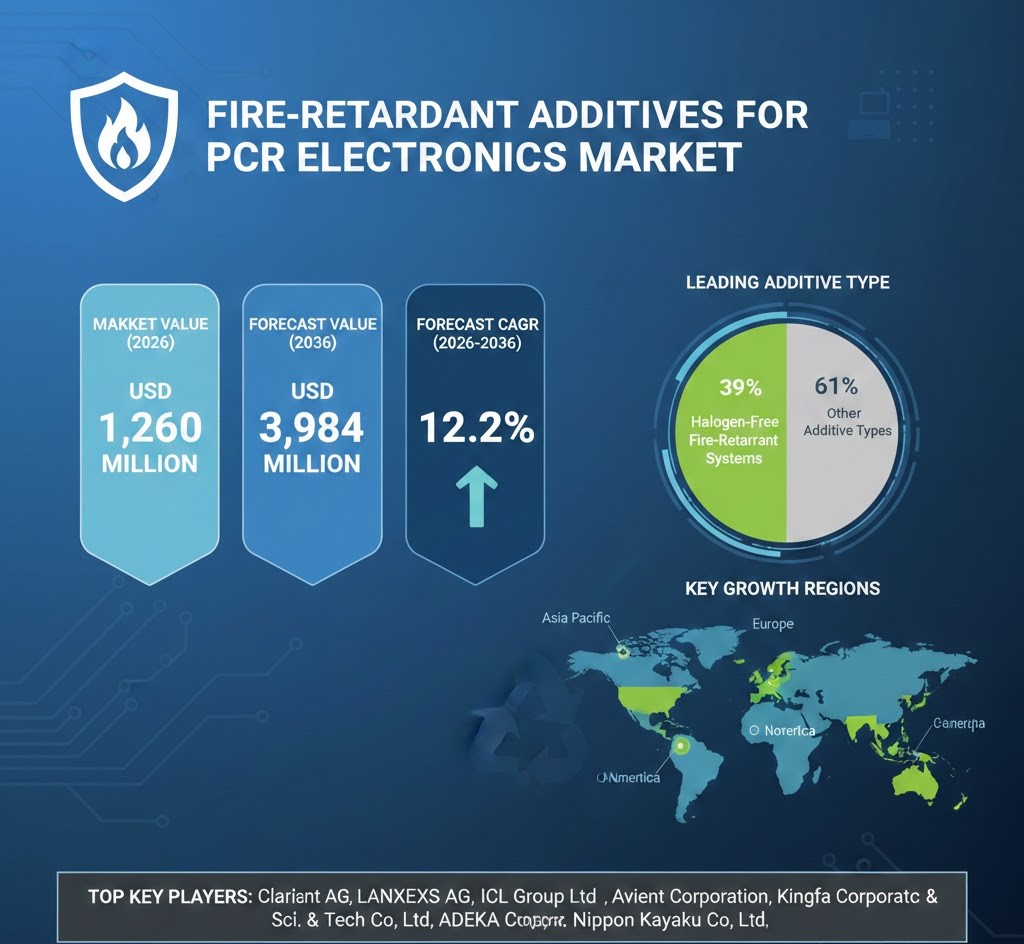
NEWARK, DE, UNITED STATES, January 29, 2026 /EINPresswire.com/ -- The fire-retardant additives for post-consumer recycled electronics market is forecast to experience robust growth, expanding at a compound annual growth rate (CAGR) of 12.2% from USD 1,260 Million in 2026 to USD 3,984 Million by 2036. This upward trajectory is largely driven by stringent flammability compliance requirements and the increasing integration of PCR plastics in consumer electronics housings and select information technology (IT) and appliance components where fire safety standards are mandatory.
Request For Sample Report | Customize Report |purchase Full Report – https://www.futuremarketinsights.com/reports/sample/rep-gb-31311
Market Context and Key Drivers
The evolving electronics industry faces dual pressures: achieving sustainability targets through PCR adoption while meeting rigorous fire-safety certifications such as UL 94 and IEC 60695. OEMs are increasingly incorporating fire-retardant additives into PCR-based polymers to ensure compliance without compromising mechanical strength, thermal stability, or dimensional accuracy.
“The fire-retardant additives market is less about widespread resin substitution and more about deep penetration in critical applications,” said an industry analyst. “Consumer electronics housings, due to their high production volumes and strict safety standards, dominate demand for these specialized additives.”
Who and What: Industry Leaders and Market Structure
Leading suppliers such as Clariant AG, LANXESS AG, ICL Group Ltd., Avient Corporation, and Kingfa Sci. & Tech. Co., Ltd. are actively advancing halogen-free fire-retardant systems, which currently hold a 39% share of the market. These systems are favored for their ability to deliver flame resistance without generating corrosive by-products, thereby preserving the integrity of electronic components.
The market segmentation includes:
• End-use: Consumer electronics housings (45% market share), IT and appliance electronics, mass electronics, precision electronics, displays, and local electronics manufacturing.
• Additive Types: Halogen-free systems, phosphorus-based additives, synergistic blends, and high-purity fire-retardant additives.
When and Where: Regional Growth Dynamics
Growth rates vary regionally, influenced by manufacturing density, regulatory frameworks, and certification rigor:
• China: Leading with a CAGR of 14.2%, driven by massive electronics manufacturing scale and rapid PCR adoption.
• United States: Growing at 11.6%, supported by large-scale consumer electronics and data-center hardware production.
• Germany: Expanding at 11%, marked by strict safety certifications and industrial electronics demand.
• South Korea: CAGR of 10.4%, linked to semiconductor, display, and battery electronics manufacturing.
• Japan: Growth of 9.6%, emphasizing reliability and precision in fire-retardant additive performance.
Why and How: Regulatory Pressures and Technical Challenges
Regulatory bodies worldwide, including the European Commission and International Electrotechnical Commission, enforce strict fire-safety standards that govern acceptable flame spread, heat release, and smoke generation. These requirements, combined with sustainability mandates such as RoHS and REACH directives, accelerate the shift toward halogen-free, low-smoke, and environmentally benign fire-retardant additives.
However, the incorporation of PCR plastics presents technical challenges. Variability in recycled resin properties can affect additive dispersion and flame-retardant efficacy, necessitating rigorous qualification cycles and technical validation to ensure consistent performance.
“The variability of PCR feedstocks raises the bar for additive systems,” explained a technical consultant. “Suppliers offering pre-qualified, formulation-ready additives that minimize requalification efforts are gaining a competitive edge.”
Market Opportunities and Supplier Competition
Fire-retardant additive suppliers compete on technical credibility, documented flame-retardant performance, regulatory compliance, and application engineering support rather than price alone. Key players differentiate themselves by providing extensive datasheets, certification-ready test data, and formulation expertise tailored to PCR polymers.
• Clariant AG emphasizes halogen-free, low-smoke formulations aligned with UL 94 and IEC standards.
• LANXESS AG highlights synergistic systems enhancing limiting oxygen index (LOI) values while maintaining mechanical properties.
• ICL Group Ltd. focuses on performance in rigid and engineering PCR plastics with documented reductions in peak heat release rates.
• Avient Corporation offers compounded solutions optimized for extrusion and injection molding, ensuring additive dispersion and PCR blend stability.
Specialty suppliers like JLS Flame Retardants, Kingfa Sci. & Tech., ADEKA Corporation, and Nippon Kayaku provide niche chemistries focusing on cost optimization, low migration, and thermal stability.
Outlook and Future Trends
As global electronics manufacturing expands and sustainability becomes central to material selection, the fire-retardant additives for PCR electronics market is poised for steady, long-term growth. Manufacturers will continue to demand additives that enable compliance with evolving fire safety regulations while ensuring material performance and processability in recycled resin blends.
The interplay of regulatory pressure, technical innovation, and manufacturing scale will define market winners over the next decade. Suppliers capable of delivering certification-ready, polymer-specific fire-retardant additive packages will secure leadership in this evolving sector.
About the Report
This market forecast and analysis encompasses data from 2026 to 2036, covering major geographic regions including Asia Pacific, Europe, North America, Latin America, and the Middle East & Africa. The report segments demand by additive type and end-use applications, profiles key industry players, and assesses regulatory impacts shaping the future of fire-retardant additives in PCR-based electronics.
Browse Related Insights
Bio Plasticizer Market: https://www.futuremarketinsights.com/reports/bio-plasticizer-market
Polyphenylene Ether (PPE) Alloy Market: https://www.futuremarketinsights.com/reports/polyphenylene-ether-ppe-alloy-market
Automotive Sealants Market: https://www.futuremarketinsights.com/reports/automotive-sealants-market
Soy Chemicals Market: https://www.futuremarketinsights.com/reports/soy-chemicals-market
About Future Market Insights (FMI)
Future Market Insights, Inc. (FMI) is an ESOMAR-certified, ISO 9001:2015 market research and consulting organization, trusted by Fortune 500 clients and global enterprises. With operations in the U.S., UK, India, and Dubai, FMI provides data-backed insights and strategic intelligence across 30+ industries and 1200 markets worldwide.
Sudip Saha
Future Market Insights Inc.
+1 347-918-3531
email us here
Legal Disclaimer:
EIN Presswire provides this news content "as is" without warranty of any kind. We do not accept any responsibility or liability for the accuracy, content, images, videos, licenses, completeness, legality, or reliability of the information contained in this article. If you have any complaints or copyright issues related to this article, kindly contact the author above.
