

Chain-like aligned boron nitride embedded in elastomer for thermal management in wearable electronics
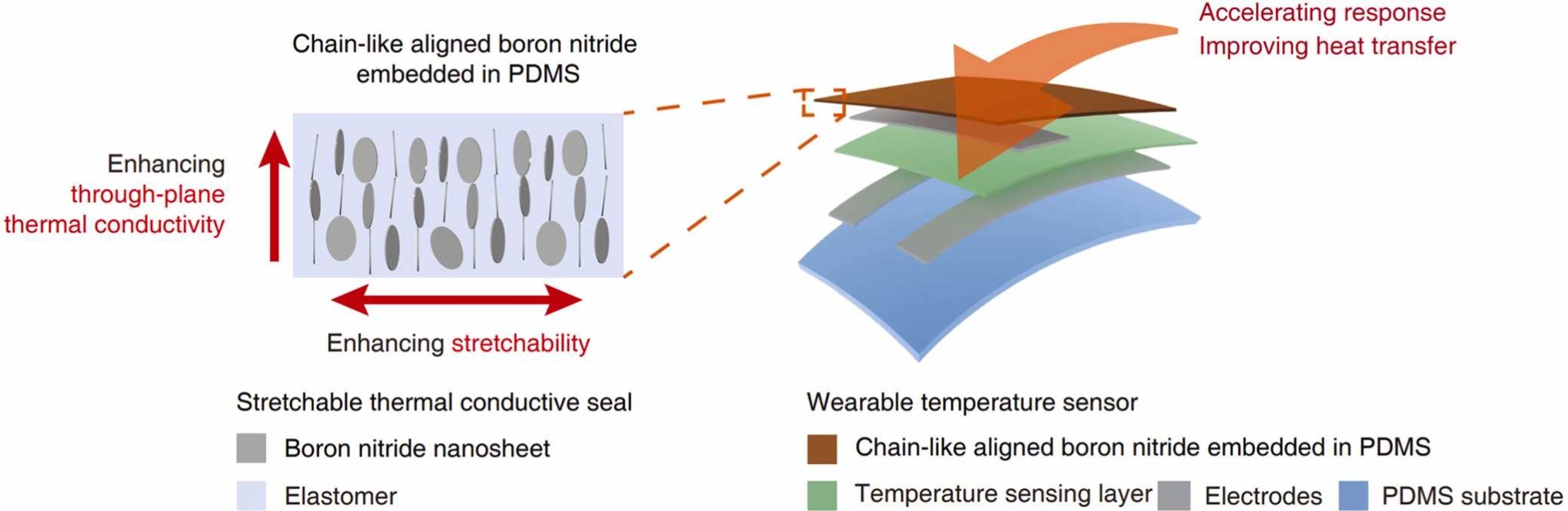
HOW THE CHAIN-LIKE ALIGNED BORON NITRIDE EMBEDDED IN ELASTOMER WORK.
GA, UNITED STATES, January 29, 2026 /EINPresswire.com/ -- Researchers developed a flexible composite by magnetically aligning boron nitride flakes into vertical chains within silicone rubber. This structure achieves an out-of-plane thermal conductivity of 1.57 W·m⁻¹·K⁻¹ at just 20% filler content—over 8 times higher than pure rubber—while maintaining 134% stretchability. The material reduces LED operating temperature by ~37% and accelerates flexible temperature sensor response by 54%, offering a potent solution for thermal management in wearable electronics.
Wearable electronics like fitness trackers and medical monitors are getting more powerful, but nonetheless, their tiny components generate heat that can’t easily escape through the soft, rubbery materials that wrap them. This heat buildup slows down sensors, drains batteries faster, and can even become uncomfortably warm or unsafe on the skin.
To solve this challenge, a team of researchers from Peking University developed a method to embed aligned filler network within the soft rubber material itself. They took tiny flakes of boron nitride—a ceramic that efficiently conducts heat along its surface—and coated them with magnetic nanoparticles. When mixed into liquid silicone rubber (PDMS), a magnetic field was used to align these magnetic flakes head-to-tail, like strings of microscopic beads. As the rubber cured, these aligned chains locked into place, creating direct vertical pathways—essentially "thermal highways"—for heat to travel through.
“The real challenge was getting these heat-conducting flakes to stand up straight inside the thick, viscous rubber before it solidified,” explains lead author Yu-Qing Zheng. “Earlier methods that used short magnetic field treatment couldn't achieve full alignment.”
The team's main innovation was applying the magnetic field continuously for up to 24 hours, which gave the flakes enough time to slowly rotate and link into continuous chains throughout the material.”
“The resulting composite material remains highly flexible and stretchable, with an elongation at break of 134%, yet it conducts heat through its thickness eight times more effectively than plain silicone rubber,” says first author Yinghong Li.
Notably, this improvement in thermal performance was achieved using a relatively low filler content (20% by weight), which helps explain why the material retains its rubber-like stretchability.
Further, in practical tests the material demonstrated strong performance in two realistic applications.
“When placed between a small LED and a heat sink, it reduced the LED's operating temperature rise by 37% within five minutes,” adds Li. “As a protective encapsulation layer for a wearable temperature sensor, it enabled the sensor to respond to temperature changes 54% faster compared to using standard rubber encapsulation.”
These findings indicate that the composite represents a practical and effective upgrade, capable of making future wearable devices safer, more responsive, and more energy-efficient.
Original Source URL
https://doi.org/10.1016/j.wees.2025.10.002
Funding information
This work is financially supported by the National Key Research and Development Program of China (No. 2023YFB3211202), National Natural Science Foundation of China (No. T2521001, No. 62374008) and the Fundamental Research Funds for the Central Universities.
Lucy Wang
BioDesign Research
email us here
Legal Disclaimer:
EIN Presswire provides this news content "as is" without warranty of any kind. We do not accept any responsibility or liability for the accuracy, content, images, videos, licenses, completeness, legality, or reliability of the information contained in this article. If you have any complaints or copyright issues related to this article, kindly contact the author above.
