

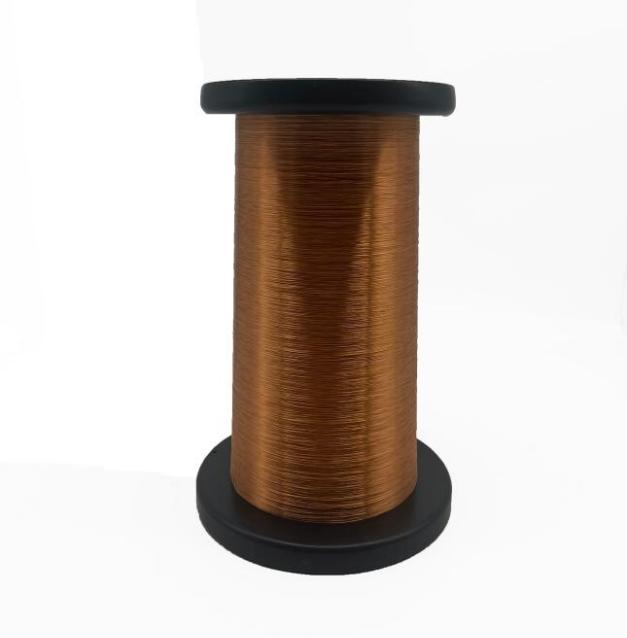
High Voltage FIW Fully Insulated Winding Wire Manufacturer: RVYUAN Strategies for IATF 16949 Automotive Compliance

Why Can't Standard Insulated Wire Handle Today's Automotive Voltage Levels?
The physical bulk of extruded insulation kills performance in tight winding spaces.
On-board chargers and DC-DC converters keep pushing toward higher operating voltages because it cuts current and shrinks thermal losses. But inside the transformer, you still need wire that fits into a fixed winding window. Traditional triple-insulated wire wraps thick plastic around the conductor. That extra diameter eats into your slot fill. Fewer turns fit. Heat builds up faster because there's less copper and more plastic per unit volume.
There's a mechanical problem too. When you bend stiff extruded wire tightly during automated winding, those thick layers crack. Not always visibly. Micro-cracks. They don't show up in initial testing but degrade dielectric strength over thousands of thermal cycles.
FIW takes a different path. Multiple thin enamel layers replace the single thick jacket. You get the same voltage withstand in a noticeably smaller package. A 0.355mm FIW wire delivers breakdown performance comparable to a bulkier extruded wire while leaving room for additional turns. More copper in the window means lower winding resistance and better heat dissipation.
What Does IATF 16949 Actually Look Like on a Wire Production Floor?
It looks like people watching screens, not inspecting finished spools.
That's the real difference between a manufacturer that treats IATF 16949 as a wall certificate and one that lives it. For a high voltage FIW fully insulated winding wire manufacturer working with conductors thinner than a human hair, you cannot rely on catching problems after the wire is wound onto a spool. The damage is already done.
RVYUAN runs Process Failure Mode and Effects Analysis on every stage — drawing, cleaning, multi-pass enamel coating, baking. They map out what can go wrong and build controls around each risk:
Enamel thickness drifting during a long production run? Inline optical sensors flag it within seconds.
Pinholes forming in the coating? Continuous high-voltage spark testing catches them across the full wire length.
Concentricity wandering on sub-0.10mm diameters? Laser measurement systems track it pass by pass.
Oven temperature creeping outside window? Automated alerts and batch segregation kick in immediately.
Every spool links back to its copper ingot lot number, the specific die set used, oven profiles, and ambient humidity readings. If a customer finds an issue six months later, RVYUAN can pull up exactly what happened during that production run. Automotive Tier 1 suppliers audit this traceability regularly, and it has to hold up under scrutiny.
Which Standards and Certifications Apply to Automotive-Grade FIW?
RVYUAN's FIW products carry VDE and UL certifications and conform to IEC 60317-56 and IEC 62368-1.(the current standard superseding the legacy IEC 60950). For automotive programs, the product documentation package supports PPAP submission and IMDS material declarations, aligning with the traceability requirements Tier 1 suppliers enforce under IATF 16949. The Class 180 thermal rating means the wire maintains electrical and mechanical properties under sustained temperatures that automotive power electronics hit routinely.
What matters practically for design engineers:
Wire diameter range: 0.06mm to 0.40mm in single-conductor FIW; litz configurations reach 0.710mm
Dielectric performance: meets reinforced insulation per IEC 62368-1
Solderability: direct solder-through without stripping — no special tools needed
Flexibility: processes cleanly on high-speed automated winding equipment without springback
That last point deserves emphasis. Extruded insulation fights you during winding. It's stiff. It wants to spring back. Operators compensate by slowing machines or adjusting tension, which introduces variability. The enamel-based FIW construction bends where you tell it to. Production speeds stay up. Reject rates stay down.
How Does Real-Time Monitoring Prevent Field Failures?
A coating variation of five microns on a 0.10mm wire changes breakdown voltage measurably. Testing one sample per hundred spools won't catch that. You catch it by never looking away.
RVYUAN's enameling lines run continuous measurement on three parameters simultaneously: concentricity, outer diameter uniformity, and surface condition. The high-voltage spark test doesn't sample — it tests every millimeter of wire at production speed.
For multi-strand litz wire — twisted bundles used in high-frequency applications to manage skin effect — monitoring extends into twisting and secondary insulation steps. Each stage generates its own data stream tied to the same batch record. An automotive customer running PPAP documentation can pull a complete process history for any delivered lot.
This isn't about impressing auditors. It's about catching the one spool in five thousand where something drifted. In automotive electronics, that one spool ends up inside someone's car.
What Should You Check When Auditing a High Voltage FIW Fully Insulated Winding Wire Manufacturer?
Datasheets tell you what a wire can do in a lab. Production audits tell you whether it does that reliably on a Tuesday afternoon in July when it's humid and the third-shift operator is running the line.
If you're evaluating a manufacturer for an automotive program, walk the floor. Ask to see:
Spark tester calibration records. How often? Who verifies? What's the acceptance window?
Die wear tracking. Drawing dies wear down. Worn dies produce inconsistent wire diameter. Good manufacturers replace dies on schedule, not when problems appear.
Corrective action logs. Not whether they exist — look at response time. Look at whether the action actually changed a process or just generated paperwork.
SPC charts for recent runs. Are critical dimensions centered and stable, or drifting toward spec limits?
Traceability demonstration. Pick a random finished spool. Ask them to trace it back to raw material. Time how long it takes.
A manufacturer that uses PFMEA findings to update control plans — not just file them — shows genuine process maturity. That's the difference between a supplier you monitor nervously and one you trust with a safety-critical component.
How Does FIW Fit Into 800V Charging Architecture?
800V on-board charger platforms stress transformer insulation harder than anything the automotive industry asked of winding wire five years ago. High switching frequency, elevated working voltage, and minimal cooling volume create conditions where material selection directly determines product lifespan.
The multi-layer enamel structure of FIW delivers reinforced insulation within a dimensional envelope that thick extruded alternatives cannot match at the same voltage class. A designer working with 0.20mm wire recovers meaningful winding area compared to an equivalent-rated extruded product. That recovered space becomes either a smaller transformer — saving weight and board area — or additional turns improving conversion efficiency.
The Class 180 rating matters here too. Inside a sealed charger housing mounted under a vehicle floor, ambient temperatures climb. Insulation that softens at sustained temperature creates latent failures appearing months into service. The enamel system holds its dielectric properties across the thermal envelope automotive qualification testing demands.
Getting Application-Specific Engineering Support
Generic catalog selections work for prototyping. Production programs need wire specified against actual operating conditions — switching frequency, peak voltage, ambient temperature profile, bending radius during winding, and solder process compatibility.
RVYUAN's engineering team provides technical consultation for automotive power electronics applications. Custom diameter selections, layer count configurations, and litz wire constructions are available through direct contact at https://www.rvyuan.com/ — working from your transformer specs and operating parameters rather than pushing standard products that may not optimize your design.
Tianjin Ruiyuan Electric Material Co.Ltd
Tianjin Ruiyuan Electric Material Co.Ltd
+ +86228-833-3337
email us here
Legal Disclaimer:
EIN Presswire provides this news content "as is" without warranty of any kind. We do not accept any responsibility or liability for the accuracy, content, images, videos, licenses, completeness, legality, or reliability of the information contained in this article. If you have any complaints or copyright issues related to this article, kindly contact the author above.
